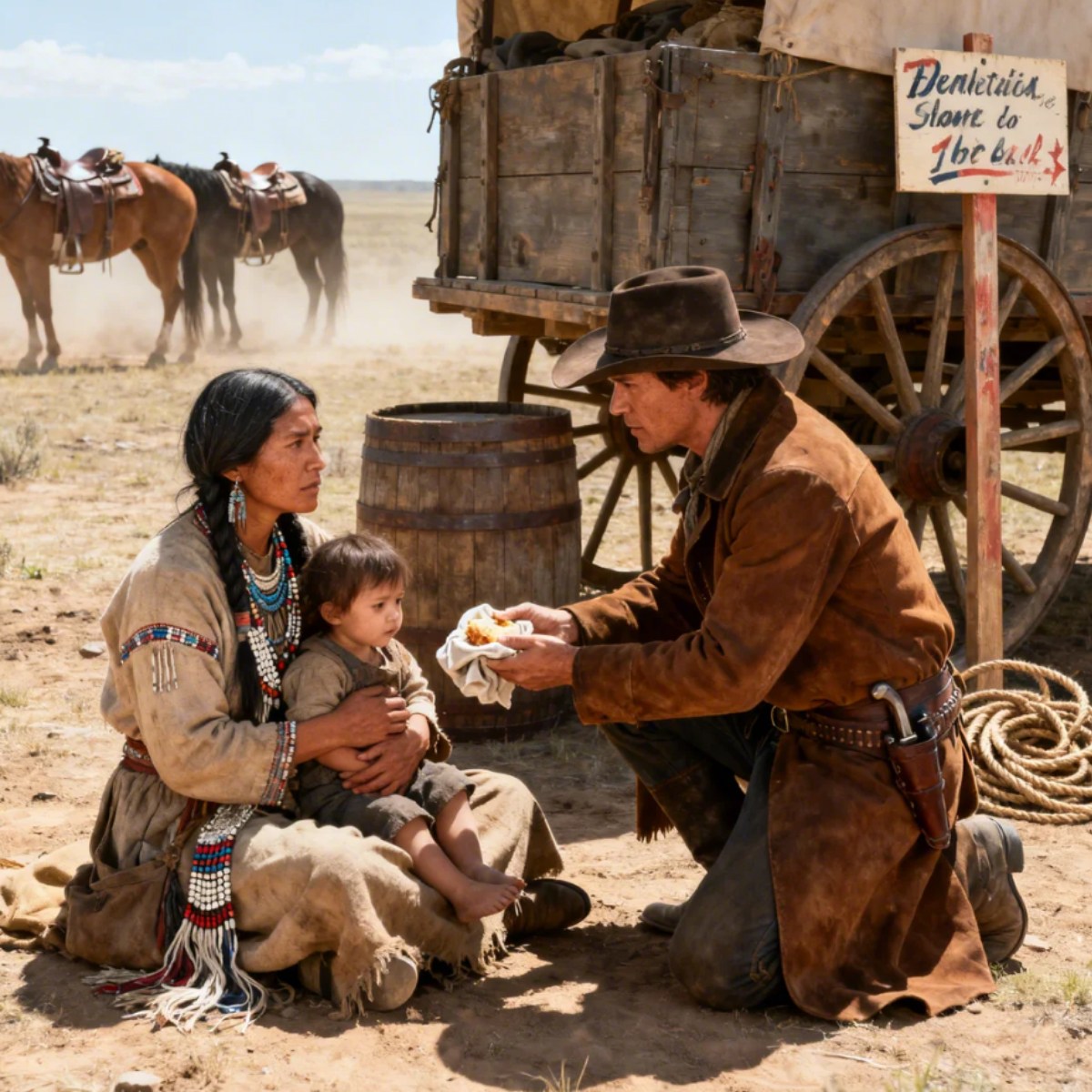
As the sun sagged over Bitter Mesa and painted the land in the bruised yellow of dying daylight, a quiet moment between a starving Apache widow and a battle-scarred cowboy exploded into one of the most divisive debates now consuming the American frontier narrative.
Because when she whispered, “Please hire me for one night… my daughter is very hungry,” she wasn’t begging for desire.
She was begging for survival.
Cole Matics, a man carved by war and regret, had only come into town for salt, nails, and enough flour to last through winter; he did not expect to witness a mother reduced to the edge of breaking.
But the sight of Ava, a trembling widow clutching her frightened little girl, exposed the merciless underbelly of a settlement already choking on prejudice, hunger, and lawless power.
Men on the saloon porch laughed at her plight, treating her desperation like entertainment, while a deputy—sworn to protect—watched with crossed arms, letting cruelty unfold unchallenged.
In that moment, Bitter Mesa showed its true face, and the internet is now asking whether Cole Matics was the only man in town who still remembered what humanity looked like.
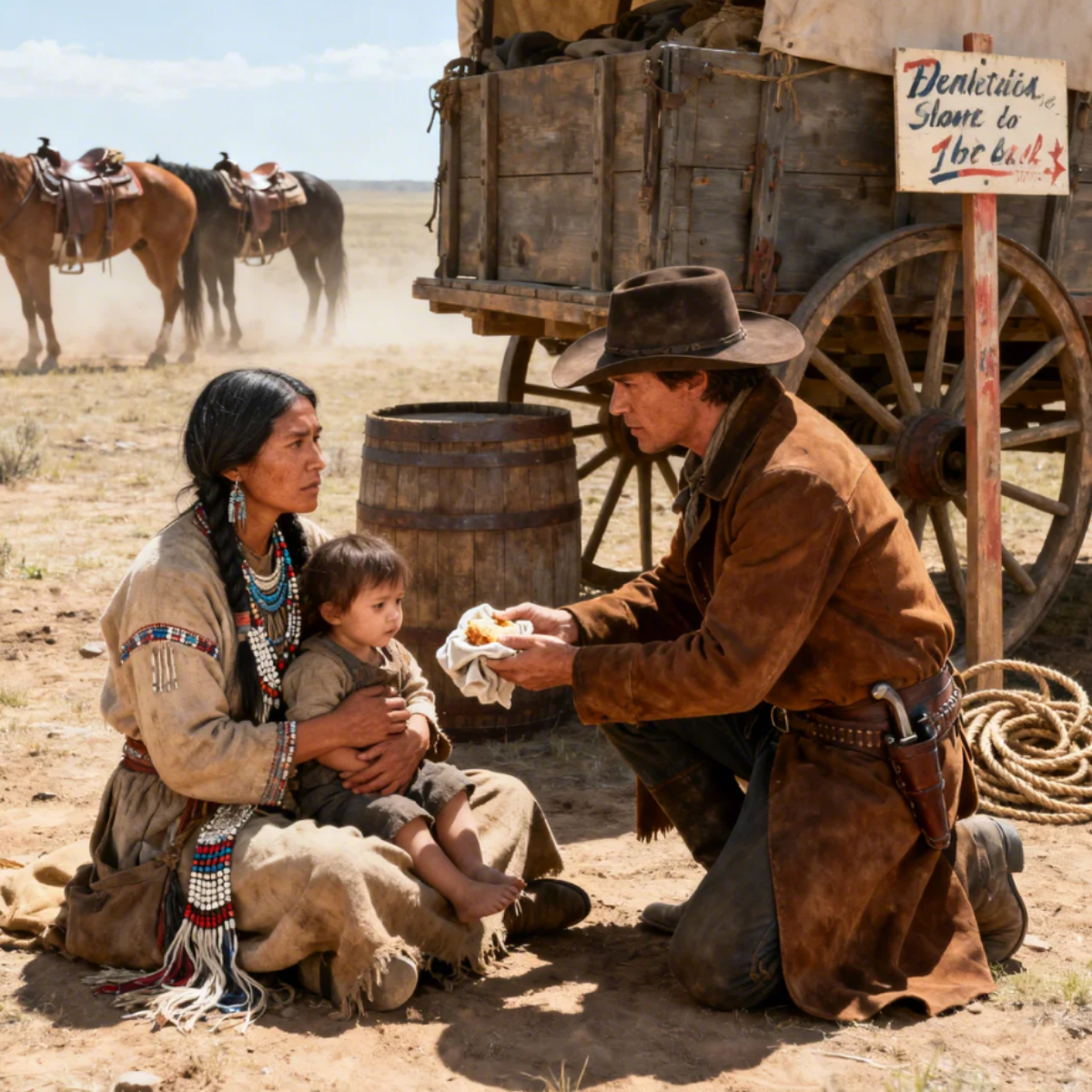
Cole, dusted from the day’s hard ride and carrying the quiet burden of too many dead soldiers haunting his memory, turned at the sound of Ava’s quivering voice—
And what he saw froze him where he stood.
Ava’s buckskin dress was torn, her braids half-undone, her lips cracked from thirst, yet her posture was one of stubborn dignity built on the last thread of hope.
Behind her, her daughter Leia clung tightly, trembling, cheeks sunken from hunger so deep that even fear had grown tired.
Cole had heard hunger before—charging across battlefields in the voices of dying boys, whispered through ghost towns swallowed by drought, screamed from railroad camps where men broke their backs for a coin.
But the hunger he saw in Leia’s hollowed eyes was different—
A hunger that should never touch a child.
Some readers describe Ava’s words as a haunting indictment of frontier survival; others argue it exposes the brutal dynamics between settlers and Native women forced into impossible choices.
Either way, the single sentence—raw, pleading, sacrificial—has become the most shared line of the week across social platforms.
Cole offered bread—not judgment, not leering interest, not the mockery twisting from the saloon porch—but simple, steady compassion.
Ava hesitated, as if kindness itself had become a trap she no longer trusted, then gently handed the first torn piece to Leia, who devoured it with trembling control, terrified the miracle might vanish.
Only after her daughter finished did Ava take her share, chewing as though rediscovering what it meant to breathe.
From across the street, two men smirked, tossing out crude comments that echoed through the dusty street like vultures circling a wounded animal.
Cole did not rise to the insult; he simply stepped forward, positioning himself between the mother and the men, his coat shifting just enough to reveal the steel glint of a revolver tucked near his ribs.
That single motion—quiet, unboastful, instinctive—ignited a nationwide conversation:
Was Cole protecting a vulnerable woman, or inserting himself into a danger he didn’t yet understand?
Was he acting from honor, guilt, or the bone-deep recognition of a fellow survivor trying to outrun ghosts?

Because make no mistake:
Ava wasn’t simply hungry.
She wasn’t merely desperate.
She was hiding.
Her shaking hands, her darting eyes, her torn neckline, her arrival alone with a child on a road known for ambushes—
All of it told Cole, a seasoned scout, that this woman had escaped something violent, something intimate, something close.
And just as this realization settled across him like desert frost, Cole noticed something the rest of the onlookers seemed determined to ignore—
The sheriff’s deputy leaning against the post, arms crossed, gaze cold, expression unreadable, watching Ava with the familiarity of a man who had already decided she wasn’t worth saving.
Online debates erupted instantly after the story surfaced:
• Was the deputy involved in whatever Ava fled?
• Did Bitter Mesa become a breeding ground for frontier corruption?
• How many other Native women vanished or suffered while lawmen looked away?
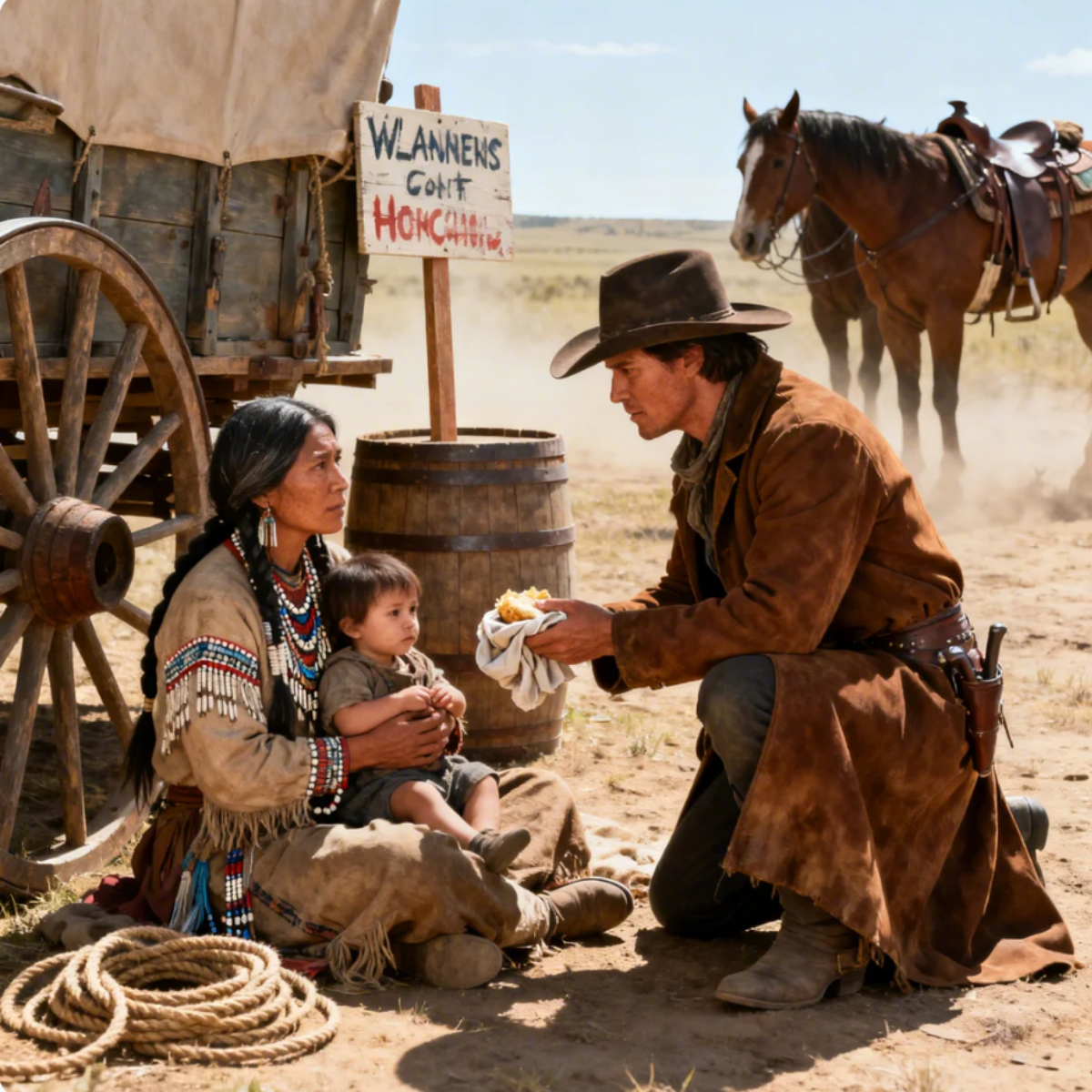
What’s undeniable is the emotional earthquake triggered by the image of a starving child tucked into her mother’s lap, begging in silence while men laughed behind whiskey bottles.
Cole Matics felt something stir in him—something older than war, older than grief—
A protective instinct buried beneath years of trying not to feel anything at all.
He had spent years letting solitude bury his demons, yet here he was, confronting a living reminder that the world still held people worth standing up for.
He offered Ava more than bread; he offered presence, shielding her from the men circling like wolves.
But the tension in the street thickened.
Ava’s breath hitched.
Leia whimpered softly.
The deputy’s hand drifted toward his holster as though anticipating a confrontation he’d enjoy.
Cole realized then that the danger wasn’t coming from the horizon.
It was already here.
Already watching.
Already weighing whether this widow and her child would be allowed to leave Bitter Mesa alive.
The sensational rise of this story across social media isn’t surprising—
It hits every nerve:
• the brutal vulnerability of motherhood
• the historical exploitation of Native women
• the moral collapse of frontier justice
• the lone cowboy forced to choose between safety and conscience
• the accusation that towns like Bitter Mesa survive on silent cruelty
And perhaps most haunting of all—
the suggestion that Ava’s plea was never meant for Cole alone.
It was a message to a world that keeps repeating its ugliest patterns.
“Please hire me for one night… my daughter is hungry,”
has become a viral cry stamped across thousands of posts, videos, and commentary threads.
Some call Ava a symbol of survival.
Others call Bitter Mesa a symbol of corruption.
And a rising number call Cole Matics the unlikely conscience of a dying frontier.
But this story has only just begun to unravel.
Because when a mother begs to save her child and a cowboy steps forward to shield them, the question that grips every reader is not what already happened—
It’s what happens next.
Who was Ava running from?
Why was Leia starving?
Why did the deputy watch without lifting a finger?
And why did Cole feel the kind of dread a man only feels when the past isn’t done hunting him?
The town of Bitter Mesa is holding its breath.
The nation is watching.
And somewhere beyond the edge of the story, the real danger is still closing in.